


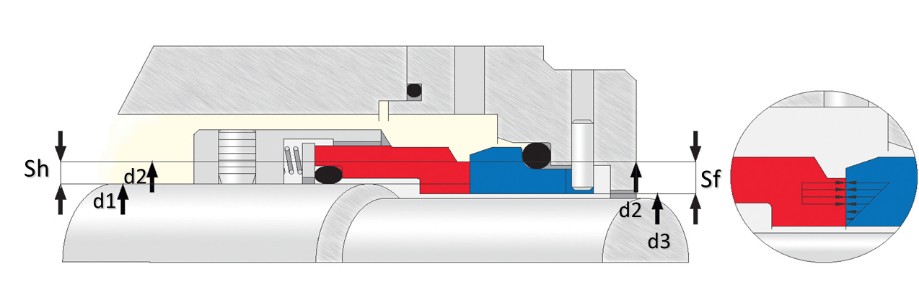
The contact between the rotating and stationary ring is guaranteed by the mechanical thrust provided by one or more springs or a metal bellows, and by the hydraulic thrust generated by the process fluid pressure acting on the annular surface of one ring against the other. The sum of these forces generates the “closing force”.
The same liquid tends to penetrate between the rotating and stationary ring, trying to separate them; the liquid pressure acting on the sealing surface generates the “opening force” which opposes the closing force.
With flat, lapped, and appropriately sized sealing surfaces, the liquid between the surfaces undergoes a pressure drop such as to reduce leakage to a few grams/hour, making it imperceptible, especially with liquids prone to evaporation.
But how are these two forces in play kept in balance? Thanks to the sizing of the annular surface on which the pressure pushes one ring against the other and the contact surface between the rings on which the pressure tends to separate them. The ratio between these surfaces defines the seal balancing.
To ensure reliable, effective, and long-lasting operation, it is crucial to evaluate the degree of mechanical seal balancing.
The closing surface and the contact surface, depending on the pressure of the fluid to be contained, generate the closing and opening force.
The closing force is calculated by multiplying the pressure of the fluid to be contained by the contact surface, according to the following formula:
Fc [kgf] = P1[kgf/cm²] ∙ S1 [cm²]
Instead, the opening force is calculated with this formula:
Fa [kgf] = P1[kgf/cm²] ∙ S2 [cm²]
For the seal to function correctly, the ratio between these two forces must remain within an optimal range.
If the balancing ratio were less than 0.6, the seal would tend to open, causing excessive leakage.
Conversely, with a ratio greater than 1.2, the closing force would be excessive to the point of not allowing the liquid to penetrate for lubrication and cooling, causing premature failure .
In practice, unbalanced mechanical seals are commonly used in applications with stable liquids and medium-low pressures, generally below 10 bar. These solutions offer a good compromise between performance and cost, making them ideal for large-scale production.
However, in more critical operating conditions, such as with fluids at high pressures or close to their vapor pressure, a balanced seal must be adopted. This type of configuration reduces friction and generated heat, ensuring greater reliability and a longer operational life.
The correct choice of balancing degree is therefore essential to optimize the performance of the mechanical seal, ensuring a balance between efficiency, safety, and durability over time.
In practice, the balanced seal is selected for:
- petroleum sector where the reference standard suggests the use of balanced seals
- energy sector in hot water and condensate applications
- in the chemical sector and in applications where the process is close to vapor pressure (evaporation point)
- in applications where the pressure x speed ratio exceeds limits defined by the seal manufacturer