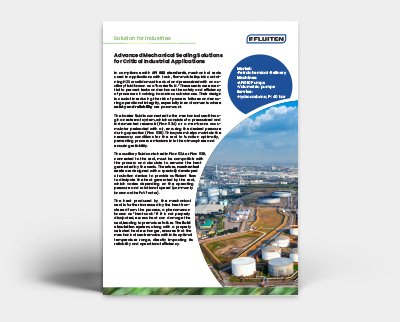
In compliance with API 682 standards, mechanical seals used in applications with toxic, flammable liquids containing H2S or solids must be dual and pressurized with an auxiliary fluid known as a “barrier fluid.” These seals are essential to prevent leaks and enhance the safety and efficiency of processes involving hazardous substances. Their design is crucial in reducing the risk of process failures and ensuring operational integrity, especially in environments where safety and reliability are paramount.
The barrier fluid is connected to the mechanical seal through an external system, which consists of a pressurized and instrumented reservoir (Plan 53A) or a membrane accumulator preloaded with air, ensuring the desired pressure during operation (Plan 53B). This system helps maintain the necessary conditions for the seal to function optimally, preventing process emissions into the atmosphere and ensuring reliability.
The auxiliary fluid contained in Plan 52A or Plan 53B, connected to the seal, must be compatible with the process and circulate to remove the heat generated by the seals. Therefore, mechanical seals are designed with a specially developed circulation device to provide sufficient flow to dissipate the heat generated by the seal, which varies depending on the operating pressure and rotational speed (commonly known as the PxV factor).
The heat produced by the mechanical seal is further increased by the heat transferred from the process, a phenomenon known as “heat soak.” If it is not properly dissipated, excess heat can damage the seal, leading to premature failure. The fluid circulation system, along with a properly selected heat exchanger, ensures that the mechanical seal remains within its optimal temperature range, directly impacting its reliability and operational efficiency.
Fluiten solution
- BM6D (Cat. II)
- CB8D (Cat I)
Fluiten offers specific mechanical seal models for demanding applications, including the BM6D for Category II applications and the CB8D for Category I applications. These seals are selected for their superior performance in handling the typical conditions of these processes. The materials used in seal construction are carefully chosen based on specific operating conditions, ensuring the seal can withstand harsh environments and maintain its integrity over time. The design is developed with precision according to the pump seal housing dimensions, ensuring a perfect fit.
For upgrading an existing seal, dimensions are designed to guarantee a plug-and-play operation, eliminating the need for pump modifications. This makes it easier to upgrade existing systems with Fluiten’s advanced sealing technology without facing significant changes, ensuring a smooth transition and minimal impact on ongoing operations.
Key Features
Dual balancing: The seal tolerates greater pressure reversal between the barrier fluid and process, allowing the use of both pressurized barrier fluid and unpressurized buffer fluid. This dual system offers greater flexibility and prevents failure in case of accidental depressurization of the barrier fluid.
Multipoint injection flushing as a standard feature, increasing cooling efficiency for sliding surfaces. This is particularly important for high-speed applications or where heat buildup is a significant concern.
FEM (Finite Element Method) analysis of sliding surfaces to minimize deformation, ensuring the surfaces maintain their shape and performance even under the most challenging conditions. This helps ensure lower emissions and higher operational efficiency.
High efficiency pumping devices designed for Plans 52, 53A, and 53B, ensuring optimal fluid circulation and cooling performance.
Cartridge construction, designed according to API 682 standards and pump dimensions, facilitating installation and maintenance.
Seal materials and metallic components selected based on strict API 682 requirements, ensuring compatibility with a wide range of operating conditions and fluid types.
Referenced by leading pump manufacturers.
Fluiten’s highly specialized technical team works on each project to find the most efficient sealing solution based on the specific process requirements. We customize our solutions to ensure not only the highest level of safety and performance but also the durability and reliability needed for continuous operation, minimizing the risk of downtime and costly repairs.
Laden Sie unsere technischen Informationsblätter herunter